
The Ultimate Guide to Landing a Job at Top Product-Based Companies: Why Referrals Are Your Only Way In
Break into top product-based companies with a product company referral—not cold ATS applications. Learn why referrals beat the algorithm, how to prep your SWE profile, and use verified marketplaces safely.
Introduction
The tech industry is clearly divided into two distinct worlds: service-based organizations and product-based companies. For ambitious software engineers, product managers, and data scientists, securing an opening at a top product-based company is the ultimate career milestone.
These organizations—ranging from massive global tech giants to high-growth, heavily-funded startups—offer unparalleled benefits. They provide immense scale, lucrative compensation packages (often including high-upside equity or RSUs), and a culture that prioritizes engineering excellence and true ownership over rapid, client-dictated deliverables.
However, because the rewards are so high, the gates are heavily guarded. When a highly anticipated opening at a product-based company goes live, it doesn't just attract a few dozen applications; it attracts thousands of resumes within the first 48 hours.
If you are trying to break into this tier of the industry, you need a reality check: applying online is a fundamentally broken strategy. To bypass the algorithmic black hole and secure an interview, you need an internal champion. You need a product company referral.
In this comprehensive guide, we will break down exactly why traditional applications fail, what top-tier engineering teams actually look for in your profile, the fatal flaws of cold networking, and how leveraging a verified insider marketplace is the safest and fastest way to accelerate your tech career.
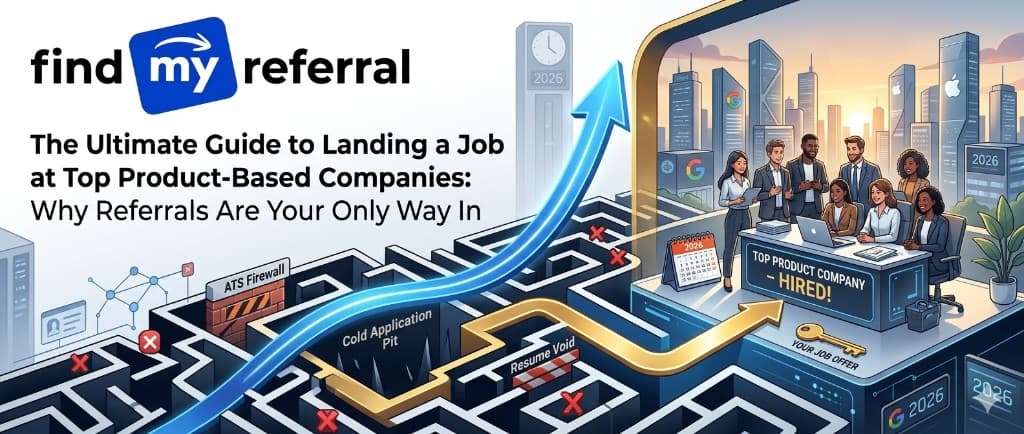
The Applicant Tracking System (ATS) Black Hole
The first step to beating the system is understanding how the system works. Top product-based companies simply do not have the human resources to manually review every resume submitted through their public career pages.
To manage the avalanche of applications, they rely on aggressive Applicant Tracking Systems (ATS) like Workday, Greenhouse, or Lever.
These systems are designed to filter out candidates, not find the best ones. The ATS scans your resume for precise keyword density, formatting structures, and specific educational or corporate pedigree. If your resume lacks the exact phrases the algorithm was programmed to find, you are automatically moved to the rejection pile.
The statistics are sobering. For top product-based companies, the conversion rate from a "cold" online application to a recruiter screen is often between 1% and 3%. You can spend weeks perfectly tailoring your resume and writing custom cover letters, only to be rejected by a machine in a matter of seconds. For the full data comparison, read cold applying vs. employee referrals.
Why Product-Based Companies Rely on Employee Referrals
To circumvent the noise of public job boards, top engineering organizations lean heavily on their internal networks. Employee referrals are the lifeblood of product company hiring for three critical reasons:
- Pre-Vetted Technical Competence: Product companies operate at massive scale. An employee who already understands the company's rigorous technical standards is highly unlikely to refer a candidate who cannot write clean, scalable code. The referral acts as a preliminary filter for technical competence.
- Cultural and Architectural Alignment: Top companies have distinct engineering cultures. They want engineers who care about ownership, system design, and long-term maintainability. When a current employee vouches for you, they are signaling to the internal reviewer that you share these core engineering values and will seamlessly integrate into the team's workflow.
- Increased Retention and Lower Hiring Costs: Data consistently shows that referred candidates move through the interview pipeline 50% faster, accept offers at a higher rate, and stay with the company significantly longer than candidates sourced from job boards. Because of this massive return on investment, internal recruiters are mandated to prioritize referred resumes above all others.
A product company referral does not guarantee you the job, but it guarantees that a human recruiter will actually read your resume. It is a VIP pass past the algorithm. Read what happens after an employee refers you for the internal process—and our referral policy for what application routing support includes.
How to Prepare Your Profile for a Top Product Company
Before you seek out a referral, you must ensure your professional profile is calibrated for the big leagues. Verified employees will not risk their internal reputation to refer a candidate who looks unready.
Product companies evaluate candidates differently than service companies. They are looking for depth, architectural awareness, and a track record of tangible impact. If you want a Senior Software Engineer to confidently refer you, your resume and portfolio must immediately demonstrate the following:
- Architectural Control (The Vanilla JS Test): Many developers claim to be frontend experts simply because they know how to string together a few React libraries, download npm packages, and apply Tailwind classes. Product companies see through this immediately. They want engineers who understand how the web actually works under the hood. To stand out, your portfolio should demonstrate strict architectural control. Instead of relying on boilerplate UI libraries, showcase complex components—such as interactive Kanban boards, data-heavy tables, or deeply nested file explorers—built entirely using vanilla JavaScript and raw CSS. Proving that you can build highly interactive, logic-heavy features from scratch signals that you have the deep technical fundamentals required to survive rigorous system design interviews.
- An Obsession with High-Scale Performance: Building a feature that works for ten concurrent users is easy. Building a feature that stays highly performant for ten million users is what product companies pay for. Your resume must reflect a deep understanding of performance optimization. Do not just list the languages you know; list the metrics you improved. Highlight your expertise in Core Web Vitals (LCP, FID, CLS). Discuss your implementation of Server-Side Rendering (SSR) or static site generation to drastically reduce load times. Mention advanced frontend architectures, such as concurrent rendering or island architecture. For example, stating, "Redesigned the PWA homepage from the ground up using Server-Side Rendering, resulting in a 20% increase in platform traffic," proves you think like a high-level product engineer.
- Enterprise-Grade Security and Compliance Awareness: Junior developers build features; senior developers build secure, compliant systems. Product companies deal with massive amounts of sensitive user data, and they need engineers who understand the gravity of that responsibility. Your resume should clearly highlight your experience with enterprise-level constraints. Mention your work with Role-Based Access Control (RBAC) systems and your adherence to Personally Identifiable Information (PII) compliance. If you have experience building or maintaining an enterprise-scale Analytics SDK utilized across multiple internal teams, put that at the top of your achievements. It proves you understand how to build robust, secure tools that other developers rely on.
For a step-by-step checklist on resume, GitHub, and referral ask prep, read 5 things to fix before asking for a software engineering referral.
The Fatal Flaws of Cold LinkedIn Outreach
Once your profile is heavily optimized for a product-based environment, you still have to actually secure the referral.
The traditional advice is to go on LinkedIn, find a second-degree connection at your target company, and send them a cold message asking for a favor. In today's hyper-competitive market, this approach is fundamentally broken.
- Severe Inbox Fatigue: Engineers and Product Managers at top companies are bombarded with dozens of cold messages every single week. They do not have the time or energy to respond to strangers begging for referrals.
- The Unpaid Labor Expectation: Submitting a referral is not a one-click process. The employee has to download your resume, log into their internal HR software (like Workday or Greenhouse), find the exact job requisition, fill out a detailed candidate submission form, and write a justification. You are asking a highly-paid professional to do 20 minutes of administrative HR data entry for free.
- The Rise of Referral Scams: Because applicants are so desperate for an ATS bypass, a toxic grey market has emerged. Scammers create fake LinkedIn profiles claiming to work at top product companies. They ask applicants for a "small fee" (paid via cryptocurrency or direct UPI transfer) to submit their resume. Once the untraceable payment is sent, the scammer vanishes.
Cold outreach is an exhausting, low-conversion, and highly risky strategy. For a deeper dive, read why your LinkedIn referral messages are being ignored and how to avoid job referral scams.
The Modern Solution: Verified Referral Marketplaces
The tech industry has evolved, and the process of securing a referral has finally been modernized. To bridge the gap between eager applicants and busy corporate employees, verified referral marketplaces have emerged as the ultimate career acceleration tool.
A platform like FindMyReferral completely eliminates the friction, the unpaid labor, and the scam risks of traditional networking by providing a secure, two-sided ecosystem. Here is why utilizing a verified insider marketplace is the only logical way to secure an opening at a product-based company:
- Guaranteed Intent and True Verification: When you reach out to an employee on a dedicated referral platform, you know they are actively looking to help candidates. They have explicitly opted in. More importantly, their identity is strictly vetted. On FindMyReferral, anyone claiming to be a insider must verify their current corporate employment by receiving a one-time password (OTP) sent directly to their official work email address. Their LinkedIn profile is also manually reviewed by platform administrators. When you search for a insider, you know with certainty that they are a currently verified employee of that specific product company.
- Fair Compensation for Time: Instead of hoping an employee will do the administrative work for free, a marketplace allows you to compensate them for their time. You pay a transparent fee to secure their application routing support. This transforms the interaction from a "stranger begging for a favor" into a mutually beneficial, professional transaction. You are paying for the verified submission of your documents directly to the recruiter's desk.
- The Milestone Protection-Style Protection System: The core innovation of FindMyReferral is its financial security architecture. You do not send money directly to an unverified stranger on the internet. When an employee accepts your routing request, the platform utilizes a secure payment gateway (like Razorpay) and an internal milestone protection-style ledger. The funds are held safely in a pending state. The employee does not receive their earnings (typically a 75% split of the fee) until they upload concrete proof—such as a redacted screenshot of the internal company portal—proving they successfully submitted your referral. If they fail to deliver, or if they stop responding, the platform's administrators review the dispute and issue a full refund. Read the milestone protection advantage for the full mechanics.
- Secure, Post-Payment Chat: To prevent off-platform manipulation and ensure clear communication, all conversation happens within the platform's encrypted chat system, which only unlocks after payment is secured in the milestone ledger. This ensures you can safely share your highly-tailored resume and exact Job IDs, knowing the transaction is fully protected.
Take Control of Your Tech Career
Landing a job at a top product-based company is not a game of chance; it is a highly calculated operation. You are competing against the brightest minds in the industry, and relying on the automated ATS to recognize your talent is a losing strategy.
Stop throwing your optimized resumes into the void. Build a portfolio that demonstrates deep architectural control, master high-scale performance metrics, and prove your understanding of enterprise-level compliance.
Once you are ready, respect your own time and the time of the professionals you want to network with. By leveraging a verified insider marketplace, you completely eliminate the risk of scams, guarantee that your application is submitted by a verified corporate employee, and finally ensure your resume gets the human attention it deserves.
Find a verified insider at your target product company, or explore companies with active insiders today.
Frequently Asked Questions
- What does FindMyReferral help applicants do?
- FindMyReferral helps applicants connect with verified company insiders for profile review, internal application routing assistance, and tracking verification. It does not sell jobs, interviews, or hiring outcomes.
- Does internal routing guarantee an interview?
- No. Internal routing can improve profile visibility and tracking context, but employers independently decide shortlisting, interviews, offers, and hiring outcomes.
- How does milestone protection work?
- Payment is tracked through FindMyReferral's milestone workflow. The insider reward is processed only after routing verification is delivered or the request completes under the platform rules.
- What should I include in a routing request?
- Include the exact job link, job ID, tailored resume, target role, key skills, and a concise note explaining why your background fits the opening.