
What Happens After an Employee Refers You? (The Internal Process Explained)
Demystify the internal referral process step by step—from ATS flagging and recruiter review to internal reviewer shortlists. Learn what a referral guarantees (and what it doesn't).
Introduction
You did it. After optimizing your resume, curating your GitHub portfolio, and finding the right verified employee, you finally secured a referral for that Senior Software Engineer role. The employee accepted your request, and you received the notification that your profile was submitted.
You take a deep breath. But as the days tick by, a new anxiety sets in. What is actually happening behind the scenes? One of the biggest sources of frustration for applicants is the "black box" of corporate hiring. Many candidates mistakenly believe that securing a referral means an automatic interview invite will land in their inbox the next morning. When it doesn't, they panic.
To navigate the modern job hunt successfully, you must understand the internal referral process. In this guide, we will completely demystify exactly what happens after an employee refers you, how Applicant Tracking Systems (ATS) handle referred candidates, and why a referral is the ultimate tool for submission, not a guaranteed job offer.
The Great Myth: Referral = Guaranteed Interview
Let's establish the ground reality of tech hiring right now: A referral does not guarantee an interview, a job offer, or even a response from the company.
If you are paying for application routing support through a verified marketplace, you are paying for a highly specific service: getting your resume out of the automated rejection pile and onto the desk of a human recruiter.
Think of a referral as a VIP pass at a crowded nightclub. The standard applicants are standing in a line wrapped around the block, waiting for a bouncer (the ATS algorithm) to randomly let a few people in. Your referral allows you to walk straight to the front of the line and hand your ID directly to the manager.
However, you still have to pass the dress code. The manager still has to look at your profile and decide if you are what they are looking for tonight. Read our referral policy for the exact scope of what application routing support includes.
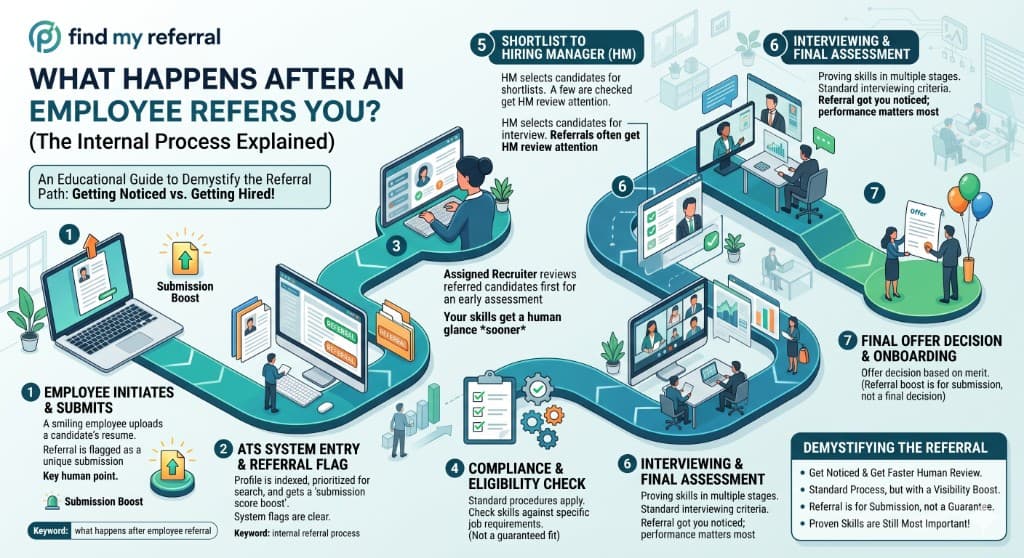
Step-by-Step: The Internal Referral Process
So, what exactly does the employee do, and where does your resume go? Here is the standard operating procedure for top tech companies using platforms like Workday, Greenhouse, or Lever.
- Step 1: The Internal Portal Submission: The employee logs into their company's internal HR portal and submits your profile through an official "Refer a Candidate" form—not by emailing your resume directly. They provide your resume, contact information, the exact Job ID, and answer a questionnaire about how they know you and how they rate your skills. This is why a tailored resume and strong pitch matter.
- Step 2: The ATS Flagging and Prioritization: Once submitted, your profile enters the Applicant Tracking System with a special digital tag: Referred. Unlike cold applications parsed by keyword algorithms, your application skips the filter and drops into a high-priority queue. Many companies require recruiters to manually review referred candidates within 72 hours.
- Step 3: The Human Recruiter Screen: A human being opens your resume and scans it against the minimum qualifications of the specific Job ID. If the role requires 5 years of backend architecture experience and your resume only shows 1 year of frontend bootcamp projects, you will still be rejected. The referral got you seen, but your skills must do the talking.
- Step 4: The Hiring Manager Review: The recruiter packages your resume along with the employee's recommendation notes and sends it to the Hiring Manager. They evaluate your profile against their immediate team needs—skills, seniority, and stack fit.
- Step 5: The Interview Loop (or Rejection): If the internal reviewer gives the green light, the recruiter emails you to set up your initial screening call. From this point forward, the referral has done its job. You are in the standard interview loop and must pass technical screens on your own merit.
Why Good Referrals Still Get Rejected
It is entirely possible to have a flawless resume, get referred by a Senior Director, and still receive a rejection email. If this happens, it rarely means the insider scammed you or didn't submit your profile.
Internal hiring dynamics are incredibly complex. You might be rejected because:
- Headcount Changes: The role was suddenly paused, or the budget was frozen, but the public job board hasn't been updated yet.
- Internal Candidates: A current employee from another department decided to transfer into the role, and companies almost always prioritize internal transfers over external hires.
- Late Timing: You were referred on Friday, but the internal reviewer had already selected three finalists for final-round interviews on Wednesday.
This is why setting realistic expectations is essential before you ever send a routing request.
Tracking Your Status: The Milestone Protection Advantage
Because the internal process takes time, the waiting period can be incredibly stressful. How do you know if the employee actually completed Step 1 (The Internal Portal Submission)?
If you just messaged someone on LinkedIn, you don't. You are left entirely in the dark.
This is why utilizing a verified insider marketplace is essential for peace of mind. On a professional platform, the entire transaction is protected by an milestone protection-style holding system.
- When you pay for a referral, the funds are not immediately released to the employee. Instead, the money sits in a secure pending state.
- The employee is required to provide Proof of Submission—usually a redacted screenshot of the internal ATS portal confirming your name and resume were uploaded for that specific Job ID.
- Only after this proof is uploaded and verified does the employee receive their earnings. If they fail to provide proof, the milestone system refunds your money.
You never have to wonder if your application actually made it inside the building. See also our guide on avoiding job referral scams for why routing verification matters.
Maximize the Opportunity
Understanding what happens after an employee refers you empowers you to take control of your job search.
You no longer have to view the hiring process as magic. A referral is a mechanical bypass—it moves your resume from the algorithmic void into the hands of a human recruiter. It is the most powerful tool in your career arsenal, but it requires you to show up with a heavily optimized resume and the exact skills the internal reviewer is looking for.
Stop hoping the ATS will pick you. Prepare your profile, connect with a verified employee through a secure marketplace, get your resume on the recruiter's desk, and let your skills secure the offer.
Frequently Asked Questions
- What does FindMyReferral help applicants do?
- FindMyReferral helps applicants connect with verified company insiders for profile review, internal application routing assistance, and tracking verification. It does not sell jobs, interviews, or hiring outcomes.
- Does internal routing guarantee an interview?
- No. Internal routing can improve profile visibility and tracking context, but employers independently decide shortlisting, interviews, offers, and hiring outcomes.
- How does milestone protection work?
- Payment is tracked through FindMyReferral's milestone workflow. The insider reward is processed only after routing verification is delivered or the request completes under the platform rules.
- What should I include in a routing request?
- Include the exact job link, job ID, tailored resume, target role, key skills, and a concise note explaining why your background fits the opening.