
Is Paying for a Job Referral Worth It? The Rise of Referral Marketplaces
Is paying for a job referral ethical, safe, and worth it? Compare the cold-application black hole, grey-market scams, and milestone protection-backed referral marketplaces.
Introduction
For decades, the golden rule of the job hunt has remained the same: to get the job, you need to know someone on the inside. Employee referrals are the undisputed king of hiring, boasting higher conversion rates, faster interview loops, and better long-term retention than any other hiring channel.
But what if you don't know anyone?
Historically, candidates have been told to network aggressively—to send hundreds of cold messages on LinkedIn hoping a benevolent stranger will take pity and submit their resume. However, as the tech industry has grown more competitive, this strategy has collapsed under its own weight. Employees are fatigued by overflowing inboxes, and applicants are exhausted by the silence.
This friction has given birth to a controversial but rapidly growing trend: the option to pay for job application routing support.
As verified referral marketplaces begin to disrupt traditional networking, a critical debate has emerged. Is it ethical? Is it safe? And most importantly, are paid job referrals actually worth the investment? Let's break down the reality of the modern job market, the ethics of compensated networking, and how milestone protection-backed platforms are changing the game.
The True Cost of the ATS Black Hole
To understand why candidates are willing to pay for a job referral, you have to understand the alternative.
Applying directly through a company's career portal means throwing your resume into an Applicant Tracking System (ATS). For a coveted role at a top-tier tech company, your application is competing against thousands of others. The reality is that the vast majority of these resumes are never seen by human eyes. They are filtered out by algorithms looking for precise keyword matches and arbitrary formatting rules.
Consider the cost of this waiting game. If you are a Software Engineer spending three months applying to 500 jobs, tweaking your resume for every single one, and dealing with automated rejections, the mental toll is massive. More importantly, the financial toll is staggering. Every month you remain unemployed (or underemployed) costs you thousands of dollars in lost potential salary.
In this context, paying a small, one-time fee to guarantee that your resume instantly bypasses the ATS and lands on a recruiter's desk is not an act of desperation—it is a calculated investment in your most valuable asset: your time.
The Ethics of Paid Job Referrals: Are You Buying a Job?
When people first hear about the concept of paid job referrals, they often have a visceral reaction. Isn't that just a bribe? Are people just buying their way into companies?
This is a fundamental misunderstanding of how corporate hiring works.
You cannot buy a job. If you pay for a referral, the internal reviewer does not care. You still have to pass the recruiter screen, ace the technical assessments, solve the system design problems, and impress the team during behavioral interviews. A referral does not artificially inflate your coding skills. Read what happens after an employee refers you for the full internal process.
So, what exactly are you paying for? You are compensating a professional for their time and administrative labor.
Submitting an internal referral is not as simple as forwarding an email. An employee must read your message, review your resume, log into their internal HR portal, fill out a detailed candidate submission form, and provide a written justification. Expecting highly paid Senior Engineers or Product Managers to do this for free, for dozens of strangers a week, is unrealistic. Paying for a job referral shifts the dynamic from a "favor" to a professional transaction. See also how tech employees monetize their network for the supply-side perspective.
The Danger of the Grey Market
While the logic behind compensating employees is sound, the execution has historically been dangerous.
Before dedicated platforms existed, a grey market thrived on Reddit, Discord, and LinkedIn. Job hunters would send direct messages to alleged employees who promised to refer them for a $100 fee paid via cryptocurrency, Venmo, or direct bank transfer.
This environment is incredibly toxic and rife with scams. In the grey market, candidates face severe risks:
- Fake Employees: Scammers impersonate tech workers, take the money, and disappear.
- No Proof of Delivery: Even if the employee is real, there is no way for the candidate to verify that the referral was actually submitted.
- Zero Recourse: Because payments are made via untraceable methods, candidates have no way to get a refund when they are scammed.
Paying for a job referral in the grey market is never worth it. Read our full guide on avoiding job referral scams before sending money to any stranger online.
The Rise of Verified Referral Marketplaces
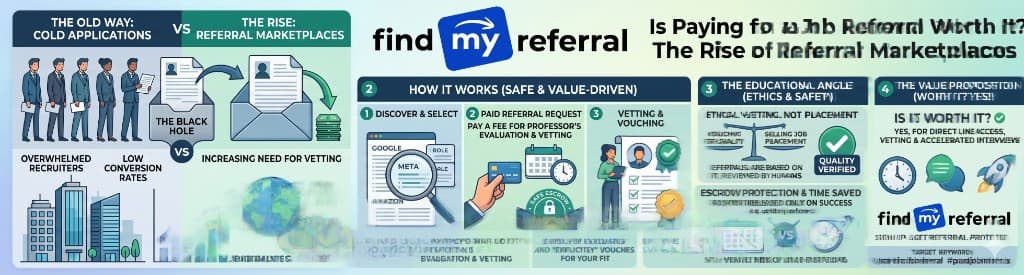
The demand for ATS bypasses and the dangers of the grey market have led to the creation of verified referral marketplaces. These platforms operate as secure, two-sided ecosystems connecting eager job hunters with verified corporate employees.
By formalizing the process, these platforms eliminate the risks and make paid job referrals a legitimate, high-ROI career tool. Here is how they completely change the equation:
- Strict Identity Verification: You are no longer guessing if the person actually works at your target company. High-quality platforms mandate corporate email OTP verification and LinkedIn admin review before insiders can accept requests. Browse verified insiders with confidence.
- The Milestone Protection System: You do not hand your money directly to a stranger. When you pay for a job referral, the platform processes the transaction via a secure gateway and holds funds in an internal milestone ledger until the employee uploads routing verification.
- Guaranteed Refunds and Dispute Resolution: If an employee accepts your request but fails to submit your resume or upload valid proof, the platform refunds your money. You only pay for successful, verified delivery.
- Setting the Right Expectations: Legitimate platforms make one thing clear: they sell application routing support, not interview guarantees. Read our referral policy for exactly what you are purchasing.
When Is It Worth It to Pay for a Job Referral?
A verified marketplace provides the safest route to a referral, but you should only utilize it if you are genuinely prepared. Paying for a job referral is highly worth it if:
- Your Resume is Flawless: Your resume is perfectly tailored to the exact Job ID you are targeting. Use our 5 things to fix before a software engineering referral guide and perfect routing request template to prepare your pitch.
- You Meet the Qualifications: A referral gets a human to look at your resume. If a role requires 7 years of enterprise architecture experience and you just graduated from a bootcamp, the human recruiter will still reject you.
- You Value Your Time: You realize that spending a small fee to guarantee your resume is reviewed is mathematically superior to spending 40 unpaid hours filling out black-hole application forms.
The Modern Job Hunt Requires Modern Tools
The days of relying solely on blind luck or exhausting cold outreach are fading. The job market is a hyper-competitive arena, and securing an internal referral is the most effective way to level the playing field.
While the idea of a paid job referral might seem novel at first, it is simply the natural evolution of professional networking. By utilizing a secure, milestone protection-backed insider marketplace, you can eliminate the scams, compensate professionals fairly for their time, and finally guarantee that your hard work gets the human attention it deserves.
Find a verified insider on FindMyReferral and take control of your job search today.
Frequently Asked Questions
- What does FindMyReferral help applicants do?
- FindMyReferral helps applicants connect with verified company insiders for profile review, internal application routing assistance, and tracking verification. It does not sell jobs, interviews, or hiring outcomes.
- Does internal routing guarantee an interview?
- No. Internal routing can improve profile visibility and tracking context, but employers independently decide shortlisting, interviews, offers, and hiring outcomes.
- How does milestone protection work?
- Payment is tracked through FindMyReferral's milestone workflow. The insider reward is processed only after routing verification is delivered or the request completes under the platform rules.
- What should I include in a routing request?
- Include the exact job link, job ID, tailored resume, target role, key skills, and a concise note explaining why your background fits the opening.
- How does FindMyReferral reduce marketplace risk?
- The platform combines corporate email verification, admin review, milestone payment protection, private chat, redacted tracking proof, refunds, and dispute review.
- What should applicants avoid?
- Avoid direct off-platform payments, anyone promising guaranteed interviews, pressure tactics, unverifiable employment claims, and requests for sensitive personal or company data.